
From the Desk · Water · August 31, 2026
Give the Data-Center Debate a Ruler
87 million gallons of water.
That is what Meta's Prineville data center used in 2024.
Big number.
Here is the problem: big compared with what?
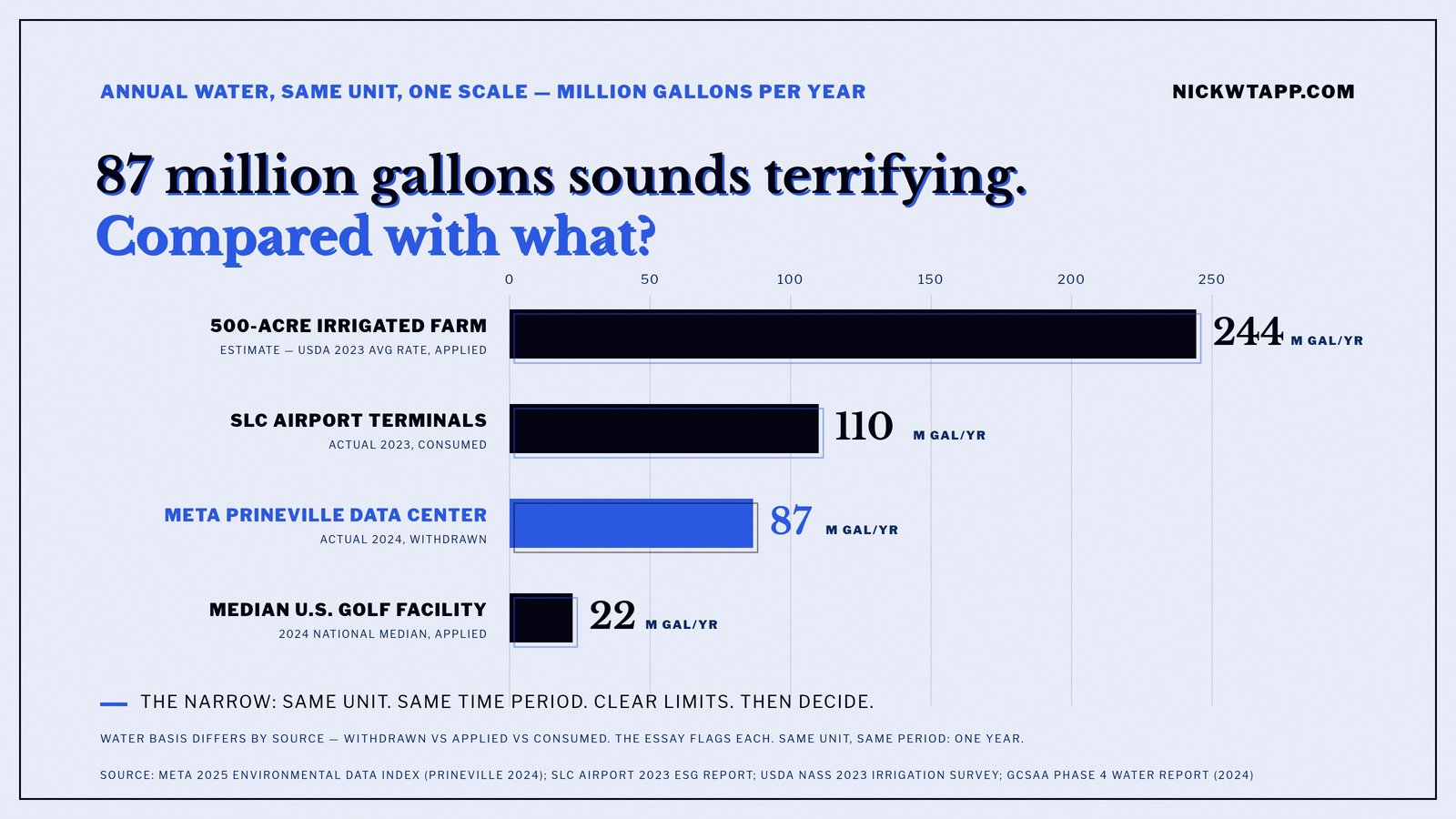
Salt Lake City International Airport's terminal buildings used about 110 million gallons of water in 2023.
A 500-acre irrigated farm, at the U.S. average rate, applies about 244 million gallons of water.
A typical U.S. golf course applies about 22 million gallons.
So the data center used about:
- less water than the airport terminals, which used about 1.3 times as much
- one-third of the 500-acre farm's water
- 4 golf courses' worth of water
Now we have a debate.
Before, we just had a very large number wearing a hard hat.
Both sides show up without a ruler
The pro side puts jobs and tax revenue in the headline and water use in the appendix.
The anti side puts "millions of gallons" in the headline and never mentions the golf course down the road applies about a quarter of that every year.
Both are counting on the same thing: that you will not ask "compared with what?"
Corporate America turned this into an art form decades ago. Every earnings call is a masterclass in picking the denominator that makes the chart point up.
A number without a benchmark is a press release. You can put one in a 47-slide deck, add a stock photo of a windmill, and call it strategy.
"A number without a benchmark is a press release."
This is not a defense of data centers
Some are being built in places where water is tight. That fact matters, and the people asking about it deserve real answers, not a vibe.
But look at the Prineville number again, and keep both directions in view.
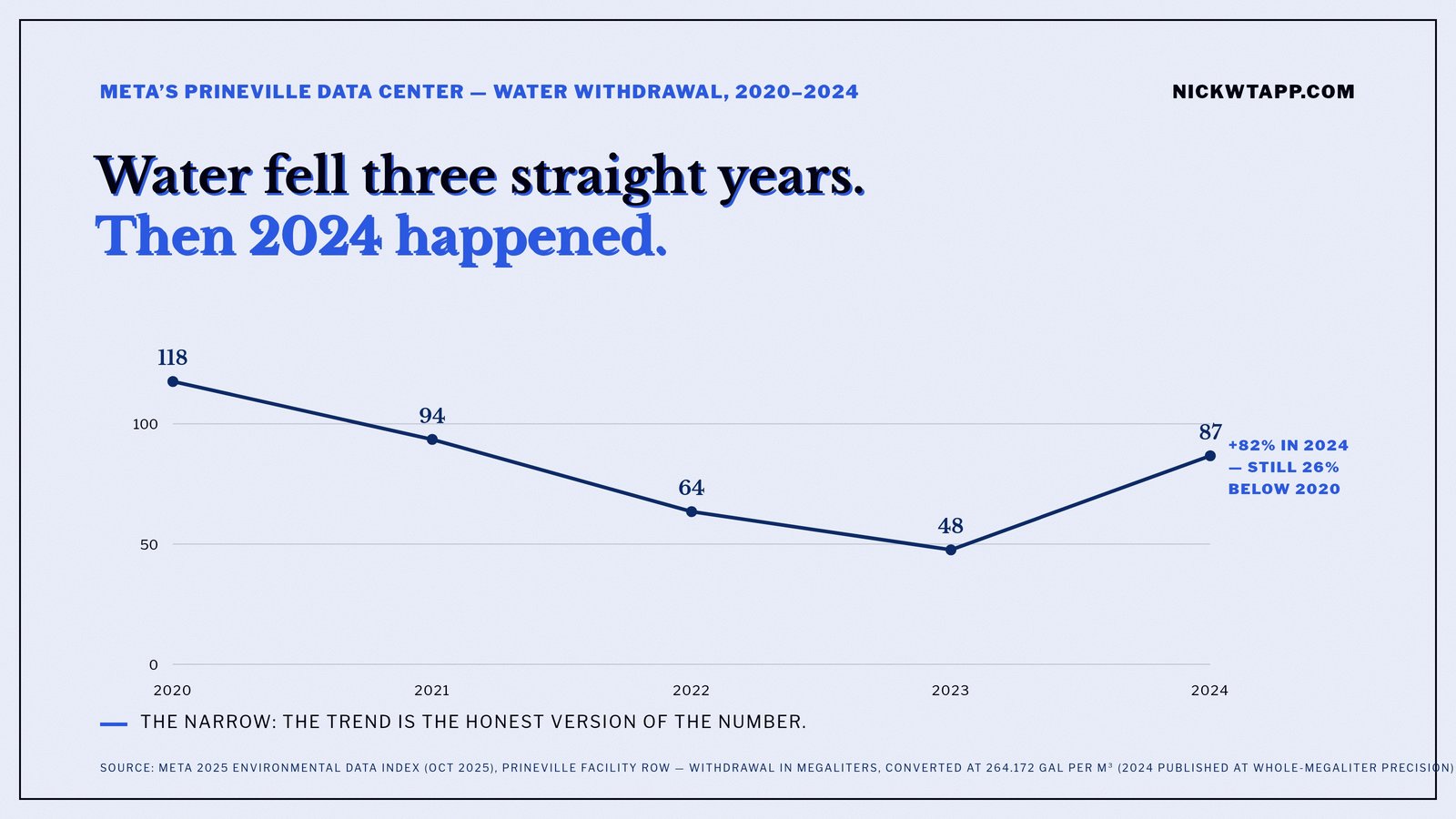
Water use at Prineville fell three straight years, then rose in 2024. It still sits 26 percent below its 2020 level.
Down, down, down, then up. Both halves of that sentence are true, and a real argument carries both.
Meta's company-wide 2024 water totals do not count another 1,019 megaliters withdrawn for data-center construction. That is roughly 12 times what Prineville used in a year, and it lives outside the headline figure.
The number comes from Meta. The source has a stake. That does not make it wrong, but it means you check the math - which is what the rest of this page is for.
Why Main Street has a seat at this table
Every AI tool a small business will ever use runs inside one of these buildings.
This buildout will shape your water rates, your county's tax base, and which towns get the construction jobs and which ones just get the pipes.
America is about to have this argument in a thousand county meetings. Both sides will arrive with the biggest number they could find, and neither will bring a denominator.
The owner of a 14-truck plumbing company does not have a policy team. But that owner pays for this buildout one way or another: in rates, in taxes, or in the cost of the AI tools the business needs to keep up.
So this is not a tech story. It is a Main Street story.
The move
You do not need to love data centers.
You need a ruler.
Is the water actually available there, at the volume promised, in the years promised? What jobs and tax dollars come back to the community? Is this a better use of the water than the things already using it?
Same unit. Same time period. Clear limits.
Then decide.
The next time someone hands you a number with nine digits in it, at a county meeting or in a headline, ask the only question that matters:
Compared with what?
7 hours.
The number shrinks the moment it stands next to an airport and a farm - that's the 8-hour part. But water use at Prineville rose in 2024 after three straight years of falling, and that earns one open eye. Groggy, not wired.
| Comparison | Annual water | Basis and limits |
|---|---|---|
| Meta Prineville data center | 87 million gallons withdrawn | Actual 2024 facility figure, Meta 2025 Environmental Data Index (Oct 2025). Water is published at whole-megaliter precision (328 ML), so 87 million gallons is the right rounding. Meta's company-wide 2024 totals also exclude 1,019 ML withdrawn for data-center construction. Company source, so it has a stake. |
| Salt Lake City International Airport terminals | 110.01 million gallons | Actual 2023 terminal figures. The broader airport campus used 138.34 million gallons - about 1.6 times Prineville's water. |
| 500-acre irrigated farm | About 244 million gallons applied | Estimate: 500 acres x USDA's 2023 Irrigation and Water Management Survey national average of 1.5 acre-feet per irrigated acre (unchanged from 2018). Crop and region can move this number sharply. |
| Median U.S. golf facility | About 22 million gallons applied | 2024 national median of 68.9 acre-feet. GCSAA is an industry group with a stake. |
- 1 cubic meter = 264.172 U.S. gallons. 1 acre-foot = 325,851 U.S. gallons.
- Prineville water: 328 ML x 264,172 gallons per megaliter = 86.65 million gallons, said as 87 million (the 2025 index publishes water at whole-megaliter precision).
- Airport terminal / Prineville water: 110.014511 / 86.65 = 1.27.
- Farm: 500 acres x 1.5 acre-feet x 325,851 = 244.39 million gallons.
- Golf: 68.9 acre-feet x 325,851 = 22.45 million gallons.
- Trend: water fell three straight years, then rose in 2024, and remains 26% below 2020.
- Meta, 2025 Environmental Data Index (2024 data), October 2025: https://sustainability.atmeta.com/wp-content/uploads/2025/10/Meta_2025-Environmental-Data-Index.pdf
- Salt Lake City International Airport, 2023 ESG Report: https://slcairport.com/assets/pdfDocuments/Sustainability/SLC-ESG-2023_Final.pdf
- USDA NASS, 2023 Irrigation and Water Management Survey (released October 31, 2024): https://www.nass.usda.gov/Newsroom/2024/10-31-2024.php and https://data.nass.usda.gov/Publications/Highlights/2024/Census22_HL_Irrigation_4.pdf
- Golf Course Superintendents Association of America, Golf Course Environmental Profile, Phase 4: Water Use and Conservation Practices (2024): https://www.gcsaa.org/docs/default-source/what-we-do/gcep-phase-4-water-report.pdf
- Auto assembly plant water: no matching plant total published.
- "Typical large data center": there is no stable typical. The essay uses one named large campus with an actual, published water figure instead of pretending an average exists.